
Major sports streaming isn’t just “regular streaming, but bigger.” It’s a real operational challenge. All the viewers arrive at once. Traffic spikes again when something dramatic happens. Rights protection, ad workflows, and manifest manipulation all need to execute under pressure.
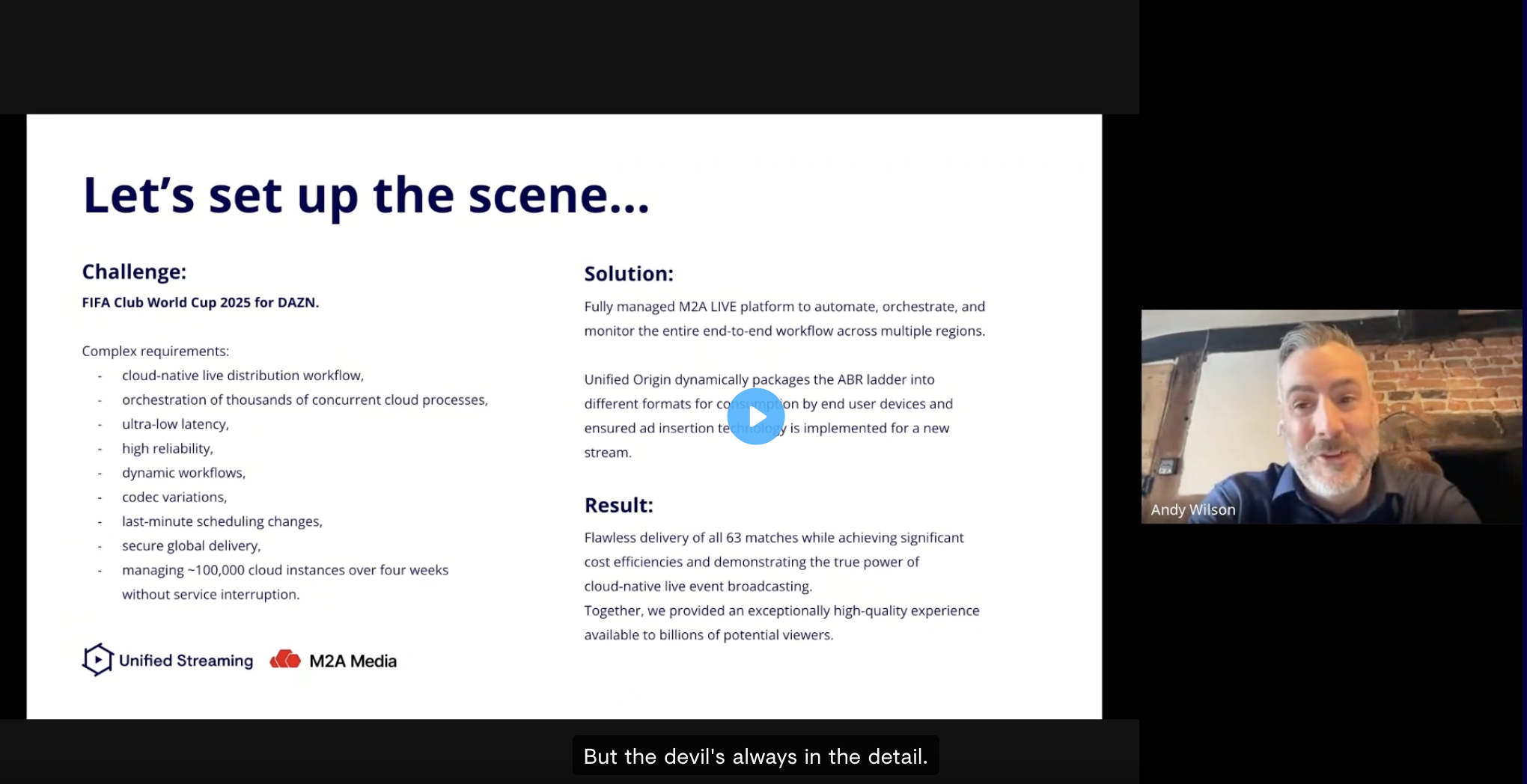
That was the main theme of our webinar with M2A Media. Together we looked back at delivering the FIFA Club World Cup 2025 for DAZN, and discussed how the industry needs to prepare before the next wave of major sports events.
Andy Wilson, SVP Customer Success at M2A Media, and Giacomo Benelli, Pre-Sales Engineer at Unified Streaming, unpacked what really matters before match day. Here are thirteen points they dwelled on.
1. In live sports, there is no second chance
Fans don’t forgive. If the stream fails during kickoff, penalties, a final goal, or even during a lull, their experience is broken, and so is their trust in their streaming platform. Viewers couldn’t care less about your workflow’s complexity.
As Andy put it during the webinar: “Live sport is one of the most insanely critical pieces of broadcast. You can’t make a mistake. There is no second chance in live sport.”
For the FIFA Club World Cup 2025, not making a mistake meant preparing a workflow that could support 63 matches, global reach, multiple territories, many language variants, and very high expectations from fans. M2A Media orchestrated hundreds of channels across multiple cloud regions while balancing availability, performance, and cost control.
Major sports event streaming balances cool features and reliability at scale. Above all, the stream must be available, stable, and ready for pressure, no matter which tech’s inside your stack.
2. Complexity everywhere
Where’s the biggest operational complexity sit? Is it ingest, encoding, packaging, ad insertion, manifest manipulation, monitoring, or regional scale? Andy’s answer was fast: “Everywhere.”
’Nuff said.
Challenges can pop up from any angle. A cloud service can’t scale quickly enough. An ad system receives too many requests at once. A DRM workflow becomes its own traffic spike. A legacy device needs a specific packaging behavior.
M2A Media dealt with feeds from different locations, multiple broadcast variants, 27 territory and language versions, dedicated channels, encoding, repackaging, and delivery to a global user base. Even when encoding and packaging are theoretically repeatable, Andy said, “the devil is always in the details.”
“Load test absolutely every portion of your infrastructure. That one small bit where you make an assumption . . . you almost guarantee that's going to kick you in the butt, when you get to the live events.”
The lesson for sports brands and streamers: don’t test only the best-case scenario. Throw everything at your systems. Test the whole chain, at the scale you actually expect, including parts you predict will “just work.”
3. Full production-scale testing is not optional
For all events, including the FIFA Club World Cup 2025, M2A don’t take any chances. .
Andy described bringing up 27 channel variants across concurrent events, with primary and backup paths, across multiple regions. The goal was to spot any weakness before the real event did.
“We literally tested at full production scale,” he said. “We had to be sure that we wouldn’t hit any other pinch points.”
So they worked closely with partners across the workflow: Unified Streaming, cloud providers, DRM partners, and others. The testing uncovered useful improvements in systems, but also showed where infrastructure-as-a-service providers could hit limits, such as times when too many resources were requested at once.
Preparation is not only about internal readiness. It is about ecosystem and partner readiness.
4. Sports traffic does not grow politely
Fans arrive at kickoff, and then more arrive when a goal happens, when the match becomes dramatic, or when clips on social media suddenly glue more viewers back to their screens for the live stream.
Andy described the “thundering herd” problem as one of the major challenges. When too many users request playback URLs, DRM licenses, manifests, ad decisions, or other services simultaneously, even strong systems can suffer.
His recommendation was to soften the spikes wherever possible. “Anything that you can do in terms of getting your audience on the platform in a staggered form is going to help you.”
That could entail diversifying endpoints by region, routing traffic to different points of presence, or even using pre-roll experiences to stall before requests hit licensing or playback systems.
Giacomo added some additional perspective. For Unified Streaming, the key from the beginning is to design tools with scalability in mind. “You have to be able to scale the resources dynamically for the peaks, but also for cost reasons,” he said.
The lesson here is, if your architecture only works when traffic is predictable, it’s not ready for major sports.
5. The packaging layer’s critical, even when viewers never see it
Viewers do not think about origins, manifests, adaptive bitrate ladders, HLS, DASH, CMAF, Smooth Streaming and other jibberish. All they think about is clicking play and enjoying the show.
But underneath that simple button, the packaging and origin layer are serving many devices, formats, regions, and network conditions. For this event, inside M2A’s workflow ran a critical component: Unified Origin - Live.
Andy described Unified Origin - Live as “an absolutely critical part” of the architecture. M2A needed sufficient capacity in various regions, flexibility across instances, automatic reselection when capacity alarms were triggered, and monitoring to ensure requests remained within acceptable response times.
Giacomo explained why a stateless origin matters at scale. Each instance can be replaced with another, and additional instances can be added as more power is needed, he said.
Origins and packaging are part of the resilience strategy.
6. More features means more compute, more testing, and more risk
DVR windows, instant replay, multiple audio tracks, multiple territories, alternative camera angles, HDR, Dolby Audio, and personalized experiences are all beneficial for viewers, but having more features creates computational pressure.
When viewers want to go back to the beginning of a four-hour event, the workflow has to maintain those windows. If ad insertion is also involved, manifest calculations can become heavy very quickly.
Andy’s point was pragmatic. If the audience doesn’t need every advanced feature, simplifying the workflow can make the event more robust overall. But if those features are required, teams need to understand the compute cost and test accordingly.
During sports events, features aren’t free. Every “nice to have” needs to be evaluated in terms of its ability to scale, its complexity, and its reliability.
7. For content protection, check multiple boxes
When global sports rights are involved, content protection figures into the operational design. And it has to work without degrading the viewer's experience.
Andy regarded DRM as the primary mechanism for content protection. You encrypt content, authenticate users, authorize sessions, and ensure people can access only the streams they’re entitled to watch.
But both speakers were clear on DRM not being enough on its lonesome. “There is no single solution to protect your content. It’s a mix of solutions that you have to apply to your stream,” Giacomo said.
That mix can include different DRM systems for different devices, forensic watermarking, and, increasingly, key rotation. Andy called high-frequency key rotation one of the next big steps in content protection, especially when combined with forensic watermarking.
There is no “silver bullet” solution for protecting the stream. You’ll always need a combination of tools.
8. Live sports monetization has its own thundering herd problem
Live sports monetization is more complex than inserting an ad and moving on. Ad markers, manifest manipulation, SSAI, SGAI, programmatic requests, personalization, regional targeting, and timing all have to operate under stress.
Ad systems can receive massive numbers of requests at once. And those requests often need to be resolved in a few hundred milliseconds.
Smooth out ad requests as much as possible, said Andy. “Do what you can to spread out those requests. As soon as a user joins the stream, why not request your first ad pod?”
They also pointed to the cost and complexity of running SSAI at a massive scale. For millions of users, full personalization can become expensive and infrastructure-heavy. That is why hybrid approaches, including server-guided ad insertion and client-side elements, can help reduce pressure while keeping monetization flexible.
Ads need to be designed and implemented as part of the live workflow, not tacked on.
9. Manifest manipulation gives teams room to adapt
One of the more practical parts of the conversation was manifest manipulation. M2A Media uses Manifest Edit as a layer on top of the Unified stack to support specific customer needs, legacy devices, SCTE-35 marker filtering, audio reordering, audio regrouping, and tailored manifests.
Andy explained that not everything can be solved “out of the box,” especially when supporting complex device estates and advanced viewer experiences. One example was a multi-view experience in which users could watch multiple screens in a single feed and dynamically switch audio.
Giacomo explained the value from the Unified side: manifest editing acts as a programmable customization layer. Instead of putting every possible switch directly into the origin, new use cases can be handled more flexibly through plugins and targeted changes.
Resilience isn’t just about more capacity. It’s also about having controls that let operators adapt the experience under pressure.
10. Device support is still a real issue
When asked whether supporting different devices is still a problem for sports streaming, Andy said, “Hundred percent yes.”
For a global audience, teams may need to support tens of thousands of device configurations. That includes modern mobile devices, smart TVs, set-top boxes, low-power devices, HDR screens, Dolby-enabled devices, and legacy environments that still require formats like Smooth Streaming.
If you want to reach a truly global audience, you need to support as many devices as possible.
This is easy to underestimate. Device support is not glamorous, but it directly affects reach. A workflow that works perfectly on modern devices but fails on older set-top boxes is not ready for global sports.
Device compatibility allows for worldwide availability.
11. Latency matters, but reliability matters more
Latency’s always a hot topic in live sports. It’s no fun hearing the neighbor celebrating a goal before you see it happen on screen.
But the webinar made an important point. That is, latency cannot be priority number one if it puts reliability at risk.
Andy explained that latency exists everywhere in the chain. Every part can be optimized, but every optimization comes with trade-offs.
“Do not start with latency as a goal,” Giacomo said. “The first thing should really be reliability and being able to serve all viewers with a good user experience.”
Low latency is valuable, but not if it makes the stream fragile. For major sports, stable playback wins.
12. Accountability requires instrumentation and trusted partners
Major sports events depend on many vendors. When something goes wrong, teams can’t lose time while suppliers point at each other.
Andy’s answer was simple. “Use telemetry,” he said. And he means use it across clients, CDNs, sessions, buffering, errors, origin performance, and traffic routing. If one CDN degrades in one territory, you need to know quickly and act quickly. Without telemetry, it’s always a guess.
He also emphasized the role of trusted partners. “You have to have a network of trusted partners to be successful delivering live broadcast video.”
Giacomo added that, as a vendor, Unified Streaming sees its responsibility as staying on top of standards and supporting customers during onboarding, customization, and real-world implementation.
No one delivers major sports alone. The platform owns the end-user experience, yes, but success depends on a well-aligned partner ecosystem.
13. Plan for things to go wrong
The final lesson may be the most important one: don’t build your workflow around the hope that nothing fails.
Giacomo said teams should plan around disasters because they will happen at some point. Despite the best intentions, CDN issues, load balancer problems, origin failures, encoder problems, network delays, or missing segments will occur.
That’s why redundant contribution, encoding, and packaging paths matter. Giacomo pointed to REaP, Redundant Encoding and Packaging, as a way to build resilience. With aligned segments across encoders and packagers, the system can substitute missing or late segments from another path.
“You always want to be in a situation where you don’t want to have a disaster, but you plan around disasters because you know they’re going to happen.”
Pretending failure will never happen isn’t a plan for resilience. Just make sure viewers don’t feel it when failure does happen.
Biggest takeaway: test, test, test
What should sports rights owners and streaming platforms fix before the next major event?
Test to find out. “Uncover every stone. Don’t make any assumptions,” said Andy.
Major sports streaming is about synchronized demand and operational complexity. Summon the discipline to test the workflow thoroughly, so you can beat the audience to the discovery that something’s wrong.
The goal is not to build a workflow where nothing ever goes wrong.
The goal is to build a workflow that’s ready for pressure and that keeps the match playing in a stable way when it matters most.