


In 2014, the streaming industry was still pretty fragmented. Standards were competing with other standards. OTT workflows were evolving. And uncertainty around the future of adaptive streaming was swirling.
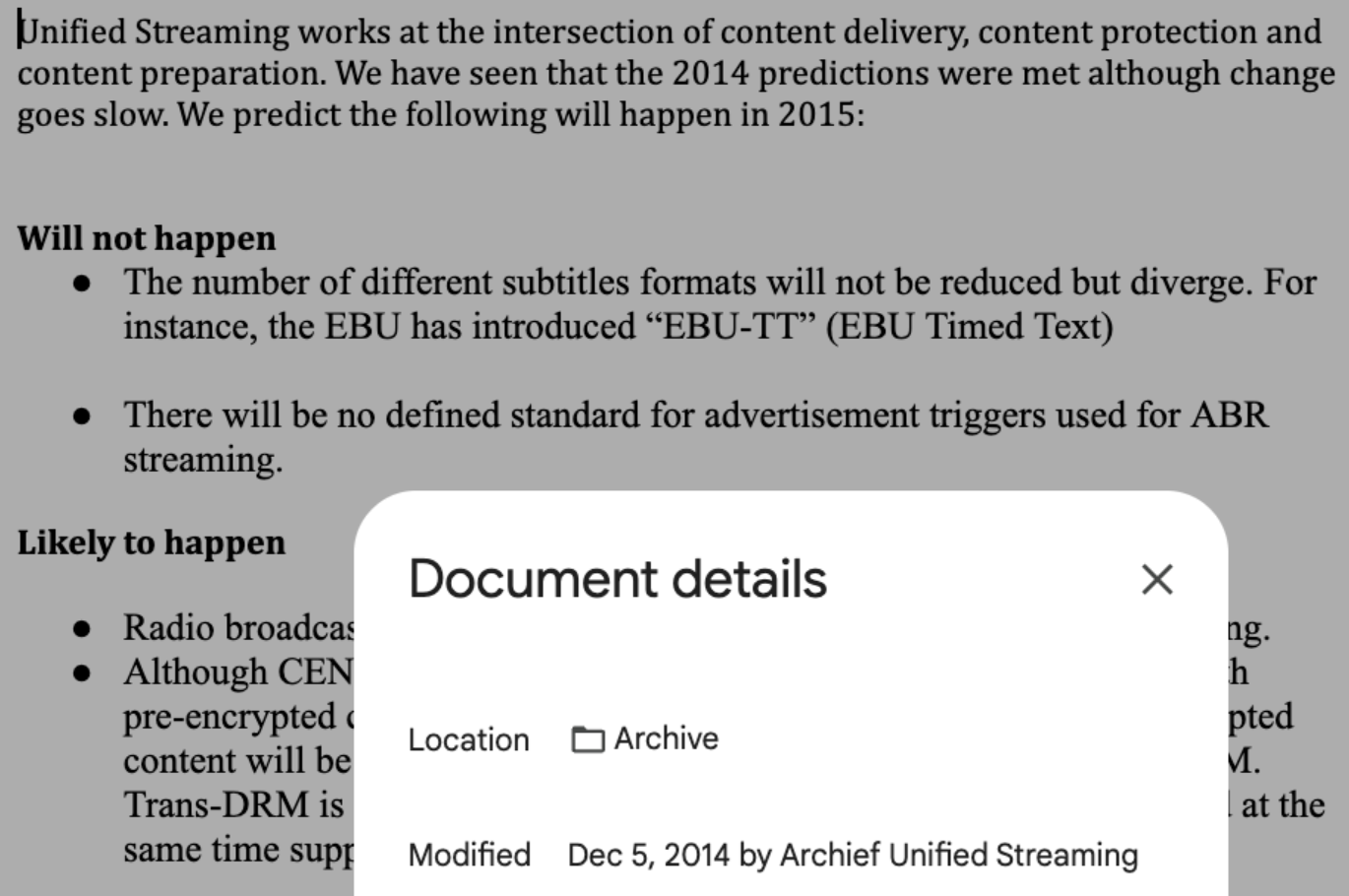
Seemed like the perfect time to predict what would happen next. So we did. On December 5, 2014, we predicted a bunch of stuff. (We found the old .docx document in our Google archive.) Above is a screenshot of the document with its details.
Then we forgot about our predictions. Twelve years flew by.
Recently we dug up that time capsule of predictions and took a look. But what good is looking back at old predictions without judging how we did? To get that critical eye, we asked our in-house expert, Mark Ogle, for his unfiltered opinions.
1. Subtitle formats
Prediction: “The number of different subtitle formats will not be reduced, but they will diverge. For instance, the EBU has introduced “EBU-TT” (EBU Timed Text).”
So in a nutshell, we guessed that all the subtitle and caption formats would not funnel into a single universal standard. Instead, new standards would continue to appear. Different industries (broadcast, web, streaming, cinema) would go with their own preferred formats. And formats would become increasingly specialized. The mention in there about the European Broadcasting Union’s EBU-TT was part of the impending divergence.
So what happened?
After 2014, new standards like IMSC, WebVTT, and CMAF-compatible subtitle workflows debuted and took their place alongside legacy formats like SRT, SCC, STL, and Teletext. Rather than doubling down on a few standards, the industry broadened the gamut of options. A translation ecosystem grew, where different subtitle and caption formats could thrive as the preferences of different professional broadcast, OTT, web, and cinema workflows. And after its introduction, EBU-TT became influential, but it sure didn’t conquer competitors.
In 2026, subtitle pipelines routinely convert between multiple standards, all depending on the delivery platform. It’s like that “Coexist” bumper sticker. In the world of streaming subtitles and captions, different systems thrive alongside each other.
So maybe this prediction wasn’t too hard to make. After all, the trend since 2014 in subs and captions mirrors a pretty common pattern in media technology: standards proliferate. Different sectors optimize for different needs. Those needs include broadcast reliability, web compatibility, accessibility, styling, and regulatory compliance.
Prediction accuracy, according to Mark Ogle:
8/10? I see a mix of both. Some places are converging and wanting to serve the same format to all devices, others preferring separate formats for different purposes.
2. ABR and ads
Prediction: “There will be no defined standard for advertisement triggers used for ABR streaming.”
Here’s what we thought back then. Even though adaptive bitrate (ABR) streaming was becoming standardized through technologies such as HTTP Live Streaming (HLS) and Dynamic Adaptive Streaming over HTTP (DASH), no single universal standard for signaling where ads should begin and end would appear, as if by magic.
Ad triggers are markers inserted into streams so players and ad systems know when to start an ad break, end an ad break, request ad decisions, and track impressions and quartiles. Yes, quartiles. Quartiles. [Now the word has taken up way too much real estate. If you didn’t know, quartiles divide ad playback length into four percentages: first quartile (25%), midpoint (50%), third quartile (75%), and completion (100%).]
Since 2015, SCTE-35 became the dominant cueing mechanism for ad opportunities. But SCTE-35 is only the cue message format. It doesn’t define a complete end-to-end standard for ABR ad insertion.
HLS and DASH implemented signaling differently, while vendors introduced proprietary workflows and APIs. Industry initiatives such as VAST, VMAP, and DASH-IF all improved interoperability. No single, end-to-end standard emerged across the slate of encoders, packagers, CDNs, ad servers, and playback devices, though.
Prediction accuracy, according to Mark Ogle:
7/10. Today, a typical live streaming ad workflow uses SCTE-35 inserted in the source feed, HLS- and DASH-specific manifest mapping, VAST responses from an ad server, and vendor-specific, server-side ad insertion logic. There’s no single standard that covers the end-to-end workflow.|
3. Radio and HTTP adaptive streaming
Prediction: “Radio broadcasters will catch up and switch to HTTP Adaptive Streaming.”
That shift did occur.
Major broadcasters including the BBC, which moved to HLS-based delivery and HTML5 playback in 2015; NPR, and many of its member stations; CBC/Radio Canada; and ARD adopted HLS and adaptive streaming workflows across web, mobile, and connected devices.
Legacy technologies such as Windows Media, RealAudio, and RTMP faded from mainstream use. HLS became especially important due to support across smartphones, smart speakers, and automotive platforms. More radio apps popped up. Radio became technically aligned with video and music streaming platforms like Spotify and YouTube.
And don’t forget the onslaught of podcasts, since 2015. They’re everywhere now.
Broadcasters repackaged shows as on-demand audio. Broadcasters also implemented AAC and HE-AAC codecs, multiple bitrate ladders, better CDN integration, and low-latency options. This all got them reduced buffering and data usage. And audio quality went up.
Though adaptive delivery became the standard architecture for large-scale radio streaming, smaller stations still rely on single-bitrate, MP3 streams. For them, there is Icecast, a free, open-source streaming media server, and SHOUTcast. Or many other alternatives. These streaming protocols don’t do adaptive streaming, but they offer other advantages: ultra-low latency, extreme resource efficiency, and near-universal compatibility.
Prediction accuracy, according to Mark Ogle:
5/10. There’s still a lot of ‘legacy’ tech out there. I think ABR radio is probably still the minority. I’m also not sure if many (or any) podcasts or music platforms like Spotify are doing DASH/HLS-style segmented ABR, rather than just serving progressive media.
4. CENC and Trans-DRM
Prediction: “Although CENC provides many benefits, we see that content owners with pre-encrypted content will require Trans-DRM. With Trans-DRM, encrypted content will be re-packaged and encrypted on-the-fly using another DRM. Trans-DRM is the only option to store a single copy of your content and at the same time support Multi-DRM—where CENC is not available.”
This prediction about Common Encryption (CENC) and the idea that operators would require “Trans-DRM” workflows to support multiple DRM systems from a single content copy came true, for the most part.
But the rise of CMAF and broad support for CENC reduced the long-term need for extensive on-the-fly re-encryption.
By 2026, most premium OTT services use a single encrypted CMAF asset combined with Multi-DRM license services rather than maintaining separate encrypted libraries. Trans-DRM remains relevant for library migrations, regional platform integrations, legacy set-top boxes, and certain offline or archival workflows. But Trans-DRM isn’t considered the only practical approach.
Unified developed something called PIFF2CENC back in early 2015, around the time of these predictions. Here’s how it works. When a company stores content that’s protected on disk in PIFF (Protected Interoperable File Format), Unified Origin can convert the content on-the-fly (dynamically) to DASH via CENC. Why? So that the content can be played out in both Smooth Streaming and DASH. Using PIFF2CENC lessens the load on servers. Companies using PIFF2CENC don’t need to re-encode, repackage, and duplicate terabytes of video content on their storage. The PIFF2CENC solution handles it at the origin server level.
Prediction accuracy, according to Mark Ogle:
6/10. CENC, yes. Trans-DRM, no. The requirement for encryption at rest can often be managed at the storage platform level, so encrypting the content as well isn't as important.
5. Single DRM providers and devices
Prediction: “Customers will not commit to a single DRM provider for all devices due to economical requirements.”
The industry coalesced around a Multi-DRM model built primarily on Widevine, PlayReady, and FairPlay Streaming. Platform lock-in, hardware trust chains, licensing requirements, and ecosystem fragmentation prevented consolidation around a single DRM system. CENC simplified operations by allowing one encrypted asset to support multiple DRMs. But it did not eliminate DRM diversity.
Multi-DRM is universal in premium streaming.
Prediction accuracy, according to Mark Ogle:
The term ‘DRM provider’ makes this prediction wrong. 3/10. There are multiple DRM systems (Widevine, FairPlay, PlayReady) for different devices, but generally customers use a single provider (EZDRM, Castlabs, BuyDRM, Irdeto, etc.) to handle multi-DRM for them. CPIX was introduced as a standard protocol to communicate multi-DRM information between DRM providers and encoders/packagers.
6. Personalized streaming and dynamic ad insertion
Prediction: “Personalized streaming will proliferate. Dynamic ad insertion is the first use case.”
One of the defining characteristics of modern streaming, dynamic ad insertion is everywhere across video and audio services, and it’s used by companies including Google, Amazon, Spotify, and Comcast.
Over time, personalization expanded beyond advertising into subscription tiers, regional rights management, language selection, captions, recommendations, alternate sports feeds, and AI-driven content presentation.
Today, two viewers watching the same program may get totally different streams. Progress? You can call it progress. It depends on whether you like personalization in your streaming.
Prediction accuracy, according to Mark Ogle:
10/10. Maybe 9/10, because we expected personalized live stream content (not just ads) to be bigger than it is (yet).
7. CENC and DASH adoption
Prediction: “We have seen that 2014 was a year for slow adoption of CENC, for 2015 we will see that supporting CENC is a must and an enabler for adoption of DASH. And with the introduction of industry-grade players, DASH adoption will rise quickly.”
Before CENC, supporting multiple DRM systems often required multiple encrypted copies of the same content. CENC simplified Multi-DRM workflows and became a key enabler for premium OTT deployment.
As DASH adoption accelerated, especially across Android, smart TVs, and browsers, CENC evolved into standard streaming infrastructure. The later introduction of CMAF further strengthened this architecture by allowing HLS and DASH to share the same encrypted media segments.
Now, let’s get into DASH adoption. Early DASH implementations were often unstable and incomplete. But professional players such as dash.js, Shaka Player, Bitmovin Player, and THEOplayer introduced robust DRM support, adaptive bitrate logic, subtitle handling, analytics, and advertising integration.
After 2018, CMAF helped reduce protocol differences and allowed shared segments for both HLS and DASH. So costs for supporting DASH went down. And DASH went mainstream, but didn’t go exclusive. On Android, smart TVs, browsers, and set-top boxes, DASH acted as a core protocol. HLS, at the same time, maintained its importance.
Today, most premium OTT services use DASH for many non-Apple devices, and HLS for Apple and often other platforms. They also use common CMAF segments and Multi-DRM.
In general, DRM tech has been adapted a lot more now than it was back in 2014.
Basically, once reliable commercial players emerged, DASH adoption expanded rapidly among broadcasters, OTT providers, and sports streaming platforms.
Prediction accuracy, according to Mark Ogle:
10/10. Almost the entire market is now HLS and DASH, and both are using the common encryption standard (at least HLS fmp4). Smooth Streaming and HDS are mostly phased out, except for legacy workflows and devices. Anything new is DASH or HLS.
8. HLS and longevity
Prediction: “Apple's HTTP Live streaming is here to stay.”
Did Apple’s HTTP Live Streaming remain a permanent part of the streaming ecosystem?
Did it ever. Yes. It did.
Despite talk in the mid-2010s that DASH might become the single universal standard, HLS remained dominant because of Apple device support, mature tooling, and broad deployment momentum.
Apple continued evolving HLS with features such as fragmented MP4 (CMAF) support, low-latency HLS, alternate audio, and subtitles. By 2026, virtually every premium streaming service supports HLS directly or indirectly.
Prediction accuracy, according to Mark Ogle:
10/10. No notes.
9. Instant Live-to-VOD and broadcasters
Prediction: “Instant Live-to-VOD is essential to any broadcaster.”
Prescient, people. Prescient.
The distinction between live and on-demand streaming largely disappeared over the following decade. Users now expect features such as start-over TV, catch-up playback, immediate replay, clipping, and pause/resume functionality.
Broadcasters including BBC iPlayer, ESPN, DAZN, and many public-service networks made instant replay and immediate archive availability central to their streaming services. Integrated live and VOD pipelines also improved monetization and operational efficiency.
Instant Live-to-VOD became a standard expectation, and operationally, it’s central for most professional broadcasters. Sports, news, and radio platforms all use it.
Prediction accuracy, according to Mark Ogle:
8/10. The only (slight) overstatement? Some smaller broadcasters still function without fully automated instant workflows. In some legal jurisdictions individual recordings are required, which can make implementation more complicated.
10. Optimization and the mezzanine format
Prediction: “The optimization of the video delivery chain will continue by making more functionality available on-the-fly and by using a single mezzanine format for audio, video, and subtitles. The network traffic will be further optimized by moving on-the-fly repackaging/encryption to the edges of the network.”
Yeah, pretty forward-looking. Streaming architectures increasingly shifted toward dynamic workflows in which packaging, manifest generation, DRM signaling, subtitle conversion, clipping, and ad insertion occur just in time.
CMAF became the de facto mezzanine format for video and audio, while TTML and IMSC became widely used subtitle interchange formats. The prediction that functionality would move toward CDN and edge infrastructure was spot-on as well, although encryption and packaging often remained centralized for security and operational reasons.
On-the-fly processing became mainstream. Single mezzanine architectures became standard. Dynamic packaging and encryption became core capabilities.
Solutions like TAMS have also worked towards standardizing the mezzanine format and storage interactions upstream of the packaging step.
Slightly optimistic was the part about full encryption and packaging being at every edge location. Sorry. That did not become universal.
Prediction accuracy, according to Mark Ogle:
7/10. We were wrong about the compute moving to the edge. Although we still think it’s on the horizon.
Predictions done, now it's your turn
Hindsight’s 20/20, right? But it looks like our foresight was pretty sharp, too. According to Mark, our average prediction accuracy score is 7.4. Not too shabby. Passing grade!
What are your predictions for the streaming industry’s next ten years? Have a think on it, and send us your opinions on what you predict will happen.
We’ll post all the predictions we receive, without naming who said what. It’ll be fun. We promise. Okay, we don’t promise, but a type of fun is what we predict.