
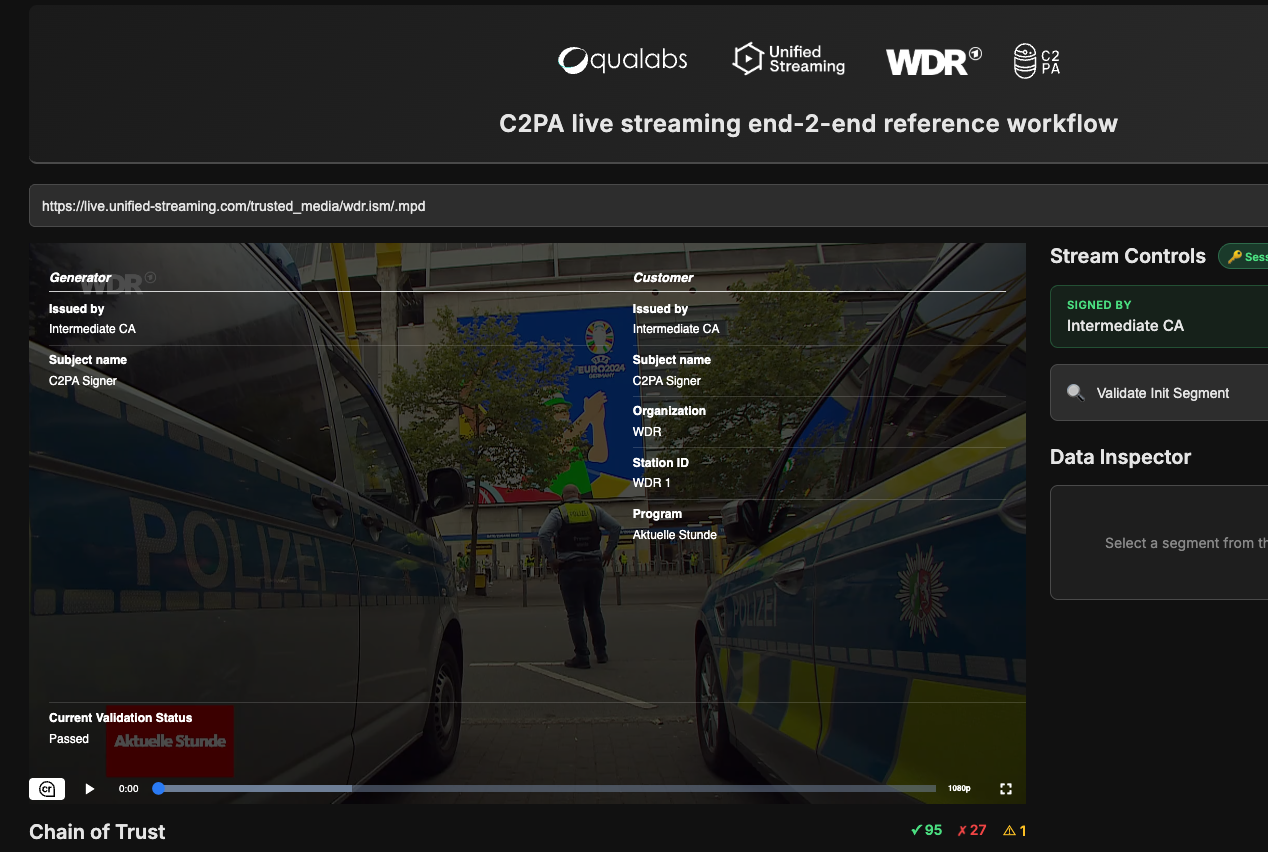
NAB Show is the annual media industry show in Las Vegas where companies display new products and solutions and discuss new ideas. At this year’s NAB Show in April, Unified Streaming, WDR, and Qualabs demonstrated something never seen before: an end-to-end, verifiable chain-of-trust for live and on-demand video streams.
C2PA (Coalition for Content Provenance and Authenticity) is the open standard that allows media to travel through the chain with a cryptographically signed record of its provenance. It’s akin to media holding a digital passport that attests to who created the piece of media, and whether the media was altered. Why does C2PA matter? Well, the more AI-generated content proliferates and refines itself by leaps and bounds, the more content authenticity concerns broadcasters, platforms, and distributors globally. It’s a matter of trust.
Challenge
Qualabs, Unified Streaming, and WDR (Westdeutscher Rundfunk) set out to cover the full media chain, from dynamic packaging to playback, joining two independent systems into a single, interoperable end-to-end implementation.
Of course, standards in streaming are always in flux, including the C2PA spec. Getting on the same page about a standard that’s evolving even as you’re implementing it is no tiny task. C2PA continually evaluates and defines new approaches for embedding provenance metadata in live video. There are new performance implications at every step.
Process
After weeks of collaborating, involving iterating, testing, and aligning, Unified Streaming got their packager and Qualabs got their validator to deliver fully compatible outputs under the most recent C2PA spec version, 2.4.
Of course, working with dependable, industry-grade components helped.
Unified Origin, trusted by major broadcasters and streaming platforms globally, did the packaging end. Qualabs brought to the table its deep expertise in video workflows and produced the open-source standards implementation. And Germany’s biggest public broadcaster WDR chipped in broadcast content tagged with full provenance metadata, including organization, station ID, and program name identifiers. Supplying metadata-enriched video for authenticity attestation experiments took the whole project up a notch.
Here are a couple points worth knowing about the implementation.
Qualabs built the demo’s user experience (UX) to be modular and open source, so that diverse teams in the industry could pick and choose what they needed. Independent packagers, signers, origin servers, stream sources, player plugins, UIs, and testing tools all came into play.
And to achieve universal compatibility, Qualabs’s validator runs in JavaScript. That way, all video-playing devices work with the implementation.
Solution
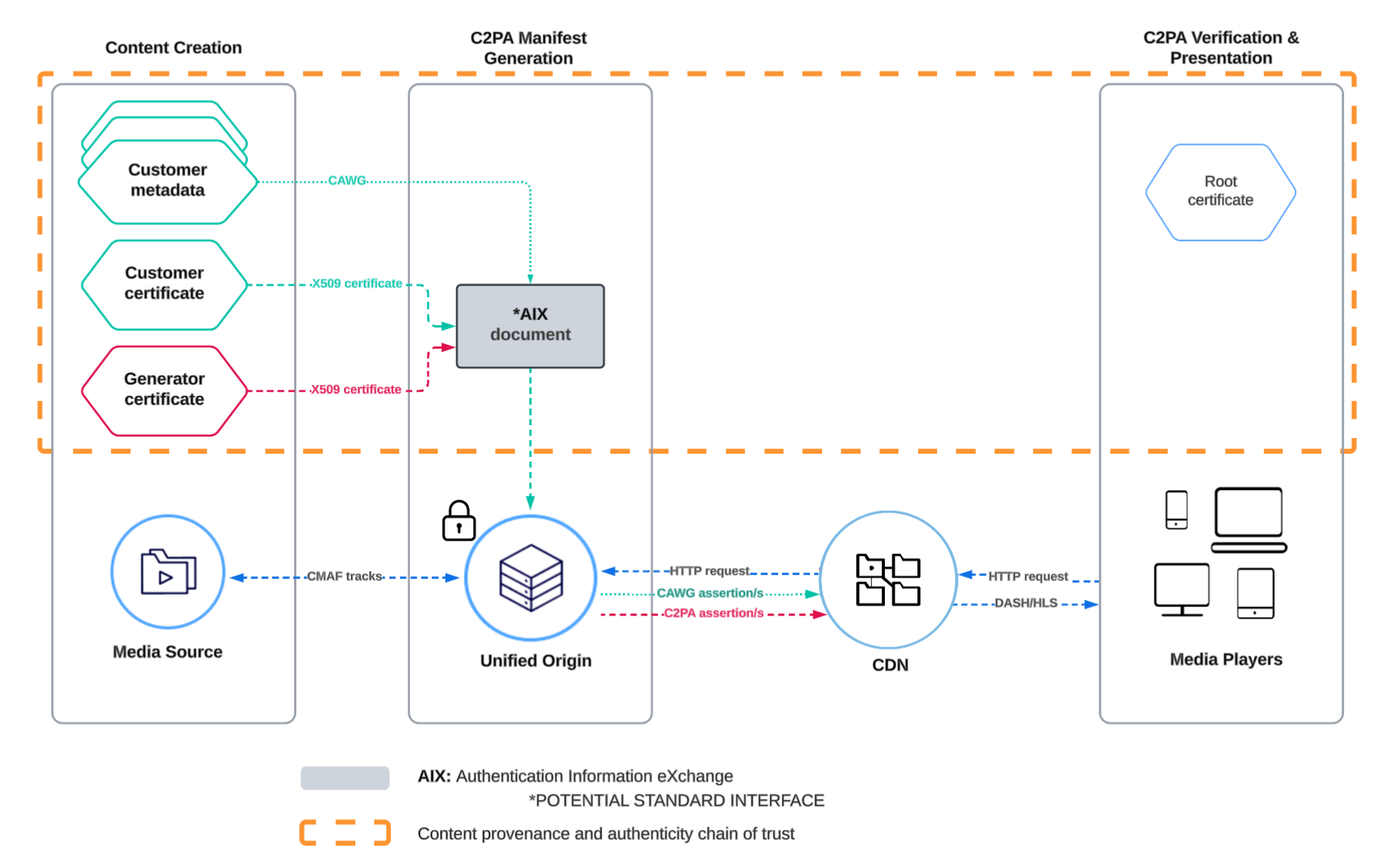
WDR content zips through Unified Origin’s dynamic packager, which signs each fragmented MP4 segment. Origin uses the credentials from the generator and the customer, ready for distribution.
Then the CDN handles delivery.
On the far end, the viewer’s end, Qualabs' validator is busy running inside the media player, verifying each segment's cryptographic signature in real time as the segment plays. These verifications of cryptographic signatures are signing off on content being authentic and not having been meddled with. All this, without interrupting playback.
The player displays content credentials in the interface. You can see who produced the content (WDR) and you can see who signed it (Unified Streaming). Operators get a transparent, verifiable chain of media provenance.
Result
This prototype demonstrates the first end-to-end implementation of C2PA for live and on-demand video, showing how real-time signing and validation work in practice. It illustrates how provenance can be embedded into streaming workflows and how authenticity information travels with video across platforms.
What the demo shows, and why we consider that important
- C2PA applied to dynamic video workflows
The demo displays how authenticity signals are added during packaging and delivery. Broadcasters, streaming platforms, and content owners that want to protect and verify video can see the whole process. - Witness timeline of concept to implementation
Get the whole enchilada. The demo shows teams how a media authenticity solution neatly integrates into existing workflows, all without messing around with major infrastructure changes or suffering any performance setbacks. - Interoperability gets its closeup
Working together speeds things up. Platforms, publishers, and third-party systems can exchange and validate provenance data across multi-vendor ecosystems. - Provenance credentials travel with content
Papers, please. A news clip shared on Insta or TikTok can be traced back to its source. Ever seen a spectacular goal in football, a “worldie”? You can verify that it happened, that it was official footage. Vids of politicians, reality stars, and other public figures can be combed through for manipulation or AI-generated edits. - Foundation built for industry adoption
The demo provides a reference approach for broadcasters, platforms, regulators, and rights holders to implement verifiable authenticity at scale as standards mature.
See the demo at c2pa-unified-streaming.qualabs.dev.
And now a word
“Working with Qualabs allowed us to turn a complex standard like C2PA into a working prototype in a real streaming environment, quickly. For Unified Streaming and WDR, this demo shows that verifiable media authenticity can be integrated into existing workflows and that provenance can travel with video across platforms, providing a practical foundation for trust in digital media,” said Unified Streaming Product Manager Linzi McRae.
End game
Remember Moore’s Law? The number of transistors on a microchip doubles every two years? 2x growth every 2 years: how quaint.
AI makes that law look laughable. AI training compute muscle grows about 750x every 2 years. AI’s knack for creating and modifying media that look authentic is on pace to outstrip our ability to determine what’s true. In a big way.
We’ll need to be able to trust what we see and hear. That’s why Qualabs, Unified Streaming, and WDR clicked into high gear. The first-of-its-kind demo implements C2PA for live and on-demand video, and shows how real-time signing and validation work in practice.
Want to see how provenance and edits can be embedded into streaming workflows, and how authenticity information can accompany video across platforms? Check out the demo. It’s available at c2pa-unified-streaming.qualabs.dev.
Read more about the solution on our Trusted Media page.