
E-messages. Just when you thought you knew all the streaming jargon.
Also called “emsg boxes,” e-messages do a lot of the heavy lifting. They tell the device what’s up, and what to do.
What’s the “e” in e-messages? Events. The “e” stands for events. E-messages are all about events.
The heck do e-messages actually do, though?
So that the device or player knows when an important event happens, e-messages attach information or instructions to video segments.
An e-message may announce to the player such as a smart TV: “Just a heads-up, sir. Something big happens here.” Another e-message might say, “Excuse me, sir, but you’re gonna wanna read this.” Still another e-message might declare, “Here’s some extra info about this segment, honey.” (Probably without the ‘honey’ part.)
More specifically, they say things like:
“Show subtitles now.”
“Display this graphic or overlay.”
“Trigger interactive feature.”
So e-messages are tasked with notifying the device about events that enhance or control the viewing experience.
E-messages are bike messengers without bikes. Their freight is instructions or data such as ad break markers; subtitle timing; DRM/license information; stream synchronization signals; and verification/authenticity metadata.
For little things, they’re a big deal.
First, though: CMAF.
What do e-messages have to do with CMAF?
Familiar with CMAF? It’s a popular format for video streaming. Instead of sending one humongous video file, CMAF goes lean and mean. It breaks video into small segments so players can download and play them smoothly.
Because the video is divided, the player often needs extra instructions tied to specific segments.
E-messages let you attach timed metadata about events to those segments, directly.
C2PA and e-messages
E-messages have a relationship with C2PA? Well, sure.
What’s Coalition for Content Provenance and Authenticity (C2PA)? The in-development standard aims to prove where media came from, who created it, who altered it, and so on. It’s a verification mechanism.
With so much AI-generated and AI-altered media cluttering the internet, C2PA can step in to record the provenance and authenticity of media files of pictures, moving pictures, and so forth.
Unified Streaming’s R&D team has been working on the standard. In fact, here’s a blog about it.
How’s C2PA use e-messages?
Well, in live streaming, you can’t sign the whole video ahead of time because, let’s be honest, the full video doesn’t exist yet. Nobody lives in the future. So C2PA may validate each segment. That is, individually. One C2PA live-video approach places verifiable segment information inside an emsg box for each segment, allowing segment-by-segment validation during playback.
That means each segment holds authenticity data saying: “This segment is legit, and hasn’t been messed with.” Or simply, “You can trust this bit.”
High-frequency key rotation (HFKR) and e-messages
In secure streaming, video is often encrypted. To decrypt it, the player needs a key. So sometimes systems rotate (change) encryption keys frequently, all in the name of security.
Instead of using one key for a long time, you may change keys every 10 seconds, or every 24 hours, or some time in between there.
This improves security because stolen keys become useless quickly. Piracy becomes a pain for the pirates. Rotating keys frequently limits the damage to any compromised stream.
Here’s where e-messages help in HFKR.
When keys change very often, the player needs to know when a new key starts, which key/license applies next, and how to switch cleanly without interrupting playback.
Guess who may be ferrying all that info? E-messages. They can carry or trigger that timing information. So they can say to the player, “At this segment, switch to the next decryption key, please, ma’am.” (Maybe they’re less polite than that.)
E-messages prove valuable in advanced DRM streaming workflows.
If you talk about DRM, in a key rotation use case, one problem that you need to solve is that, when rotating the key, all the players on the live edge will start requesting the key that you just announced. And that thundering herd can result in a potential spike of a million requests, if you have a million viewers that you need to process in about 2 seconds.
That’s just one example of the suddenness and force of simultaneous requests.
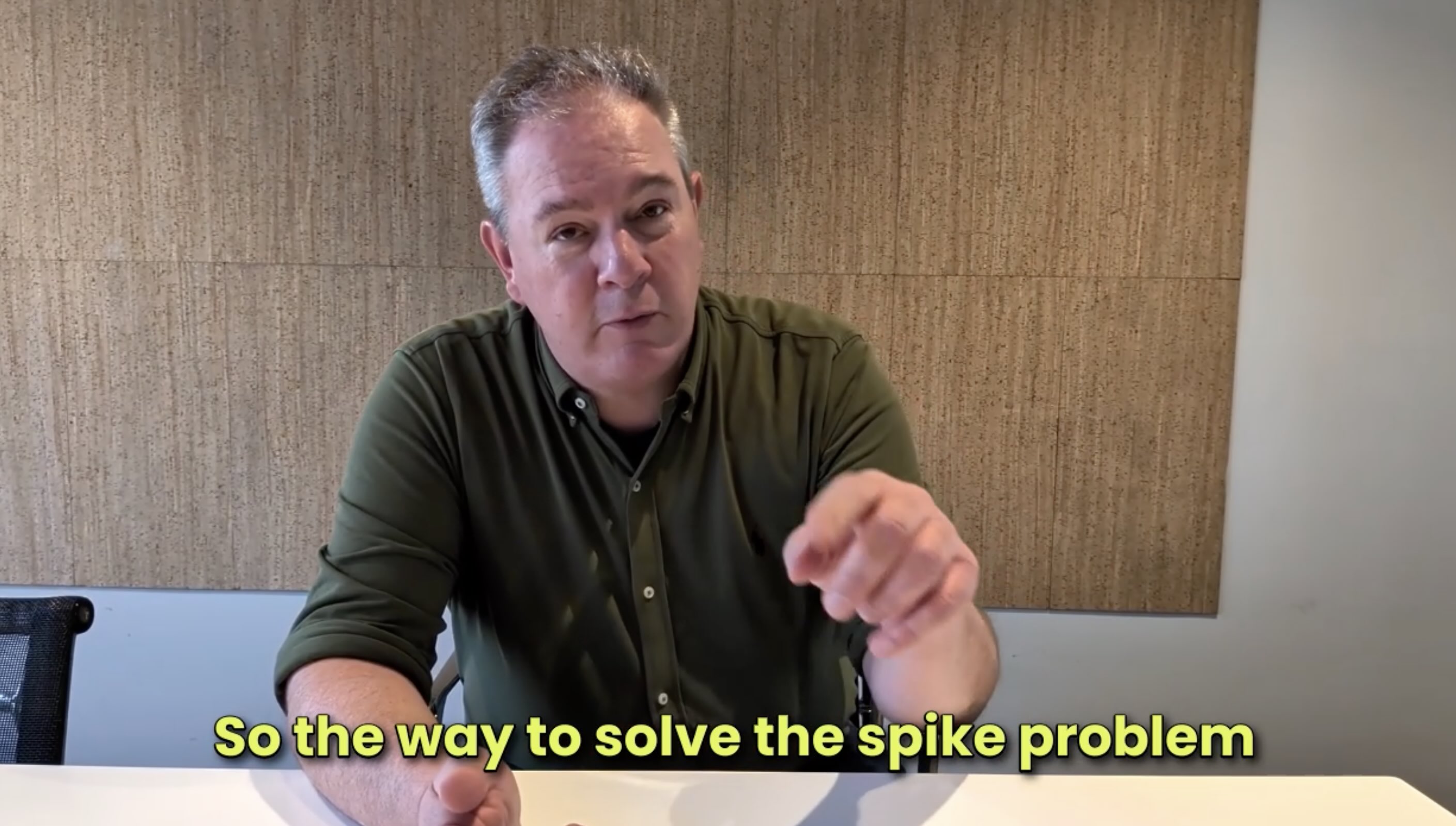
And with DRM, the problem is that every “handshake” between the client and the server is unique. It's uncacheable. So to solve the spike problem, you try to normalize the spike by pre-announcing the key IDs that you're going to use in the future.
And as soon as the player receives, via an e-message, the next content decryption metadata information, the player will resolve the key ID before it's actually being used. And the player will request it at a random time in the future to reduce the spike of requests.
How do e-messages fit into other Unified Streaming products?
Unified Streaming uses CMAF and fragmented MP4 packaging in Unified Origin and Unified Packager, which package and deliver streams in formats including CMAF, DASH, and HLS.
Within those workflows, e-messages provide the standards-based way to carry timed metadata inside CMAF/fMP4 streams.
That makes them useful in several Unified Streaming scenarios.
1. Timed metadata delivery
E-messages can carry timed events such as SCTE/ad markers, stream signaling, and custom player triggers. Whenever downstream players or services need metadata synchronized with playback, e-messages sure come in handy.
2. DRM/encryption workflows
Unified Streaming supports the majority of widespread DRM systems and encryption methods. (Little Unified Streaming marketing for your day, there.)
E-message-style timed metadata is relevant for advanced DRM ecosystems because it provides a standards-based mechanism for signaling encryption changes. Oh, and for coordinating player behavior and for aligning security events with segment boundaries, too.
3. Future, or advanced trust and verification use cases
As provenance standards like C2PA become more common, Unified-style CMAF workflows can use e-messages as the natural vehicle to carry verification metadata in live segmented streams.
Because Unified products already package standards-based CMAF/fMP4 output, e-messages fit well into workflows where segment-level authenticity or verification metadata may need to bum a ride with the media.
Yup, that’s it
You sure got your jargon fix, didn’t you?
E-messages matter because they make modern streaming smarter. They help CMAF and Unified Streaming’s core products attach important information about events directly to video segments.
Playback events use e-messages for subtitles, ads, and sync. Anti-piracy, or high-frequency key rotation situations use e-messages for coordinating frequent encryption/key changes. In C2PA (content provenance and authentication) scenarios, e-messages carry C2PA verification data. And in advanced streaming workflows, e-messages can deliver timed metadata and player signaling info.
Across all the use cases listed above, e-messages are doing the same job. They work to make a stream an event-driven system.
Instead of telling the player, “Play video from start to finish,” e-messages say this. “Play video. Event happens here, buddy. React, buddy. Continue. Next event happens here, buddy. React, buddy.” And so on.
Efficient, right? Got questions? Just reach out to one of our experts here.